

CWU Asbestos Guide Published And Available From Unionsafety E-Library
With CWU members from both constituencies perhaps having been at sometime exposed to Asbestos dust or debris, the CWU has put together this guide to one of the most hazardous and life-threatening substances manufactured by humans beings.
The guide can be downloaded in PDF format from the Unionsafety E-Library where you will find other documents on Asbestos, or directly by clicking on the image to the right.
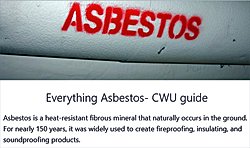 Written by CWU National H&S Policy Adviser, Jamie McGovern and his BT colleague Nick Duery, the document has been written as a Microsoft Sway document which can be viewed here
So what is Asbestos?
The CWU Guide explains:
Asbestos is a heat-resistant fibrous mineral that naturally occurs in the ground. For nearly 150 years, it was widely used to create fireproofing, insulating, and soundproofing products.
Six different minerals can be described as ‘asbestos’ and are all known carcinogens, though the three main types used in Britain were chrysotile, amosite, and crocidolite. Their prolific use in the construction, textile, automotive, and shipbuilding industries means that, even though asbestos was officially banned in 1999, the danger to British citizens’ health is ongoing.
Chrysotile (white asbestos)
Chrysotile, or white asbestos, was the most common type of asbestos manufactured around the world. Despite being the last type of asbestos to be banned in the UK in 1999, it can still be found in large quantities today.
Over the decades, chrysotile was used in many hundreds of household items, and found its way into most residences and industrial buildings.Since its fibres are fine and soft in nature, it was often woven and spun into asbestos textiles like fireproof blankets, safety clothing, and even theatre curtains.
The substance was used for acoustic and fireproofing purposes, especially for flooring, and wallboards in densely-populated areas and industrial centres alike. Chrysotile was also used by the automotive industry to make brake linings, clutches, brake pads and gaskets.
The guide goes into much more detail about the different types of Asbestos and provides qa good resource for Union Safety Reps regarding Asbestos in the workplace and in the home.
The CWU are working in partnership with other organisations for a real Government commitment to an Asbestos-Free UK by 2065.
We believe that an independent UK task force could drive forward this commitment and enhance public knowledge on the real and present problem of asbestos in the UK.
The CWU have registered an interest in becoming part of an independent UK task force.
Source: Jamie McGovern, CWU National H&S Policy Adviser
